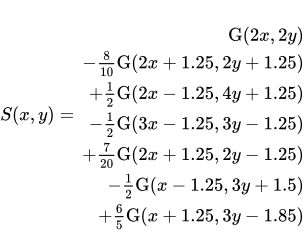
The field is a superposition of several 2D gaussian surfaces.
Define G ( x , y ) = e − ( x 2 + y 2 ) {\displaystyle {\mbox{G}}(x,y)=e^{-(x^{2}+y^{2})}}
Then, the field f used is given by the following function:
f ( x , y ) = − 4 10 S ( x , y ) + 3 2 {\displaystyle f(x,y)=-{\tfrac {4}{10}}S(x,y)+{\tfrac {3}{2}}}
Where S is the sum of the following:
S ( x , y ) = G ( 2 x , 2 y ) − 8 10 G ( 2 x + 1.25 , 2 y + 1.25 ) + 1 2 G ( 2 x − 1.25 , 4 y + 1.25 ) − 1 2 G ( 3 x − 1.25 , 3 y − 1.25 ) + 7 20 G ( 2 x + 1.25 , 2 y − 1.25 ) − 1 2 G ( x − 1.25 , 3 y + 1.5 ) + 6 5 G ( x + 1.25 , 3 y − 1.85 ) {\displaystyle S(x,y)={\begin{aligned}\\{\mbox{G}}(2x,2y)\\-{\tfrac {8}{10}}{\mbox{G}}(2x+1.25,2y+1.25)\\+{\tfrac {1}{2}}{\mbox{G}}(2x-1.25,4y+1.25)\\-{\tfrac {1}{2}}{\mbox{G}}(3x-1.25,3y-1.25)\\+{\tfrac {7}{20}}{\mbox{G}}(2x+1.25,2y-1.25)\\-{\tfrac {1}{2}}{\mbox{G}}(x-1.25,3y+1.5)\\+{\tfrac {6}{5}}{\mbox{G}}(x+1.25,3y-1.85)\end{aligned}}}
Evaluated from -1 to 1 in both x and y directions.